

How Long Does It Take to Repair Your Skin Barrier? A Realistic Timeline
Quick Summary: Skin Barrier Recovery Timeline
- Mild irritation typically improves within 7–10 days
- Moderate barrier damage may take 2–4 weeks
- Severe over-exfoliation can take 4–8 weeks to recover
- Ceramides help rebuild the lipid barrier faster
- Avoid actives until skin feels completely calm
- A consistent routine repairs skin faster than strong treatments
If your moisturizer still stings, your barrier is not healed yet.
If your skin isn’t improving after 2–3 weeks, your routine may be missing the barrier-repair ingredients it actually needs — like ceramides and panthenol. Shop the Ceramide Serum-In Cream → or get the full Barrier Rescue Pack →
Jump to a section
Why skin barrier recovery takes time
The real timeline for skin barrier repair
What your skin should feel like week by week
Factors that affect your recovery timeline
What speeds up skin barrier repair
What to eat during barrier repair
The biggest mistake: restarting actives too soon
Personalized routine matters
Why Korean skincare focuses on barrier health
Build your barrier recovery kit
FAQ
Why Skin Barrier Recovery Takes Time
When your skin barrier is damaged, the protective lipid layer becomes disrupted.
The skin barrier’s lipid structure is essential for regulating moisture and protecting against environmental stressors. When this structure is compromised, it increases transepidermal water loss (TEWL) — meaning your skin loses moisture faster than it can replace it.
As hydration escapes, skin becomes:
- Tight
- Sensitive
- Red
- Reactive
- Dehydrated
Barrier repair is not instant because your skin must rebuild its lipid structure, especially ceramides, cholesterol, and fatty acids. These lipids form the protective “mortar” that holds your skin cells together.
Learn more about rebuilding the lipid barrier in our complete ceramide repair guide.
The Real Timeline for Skin Barrier Repair
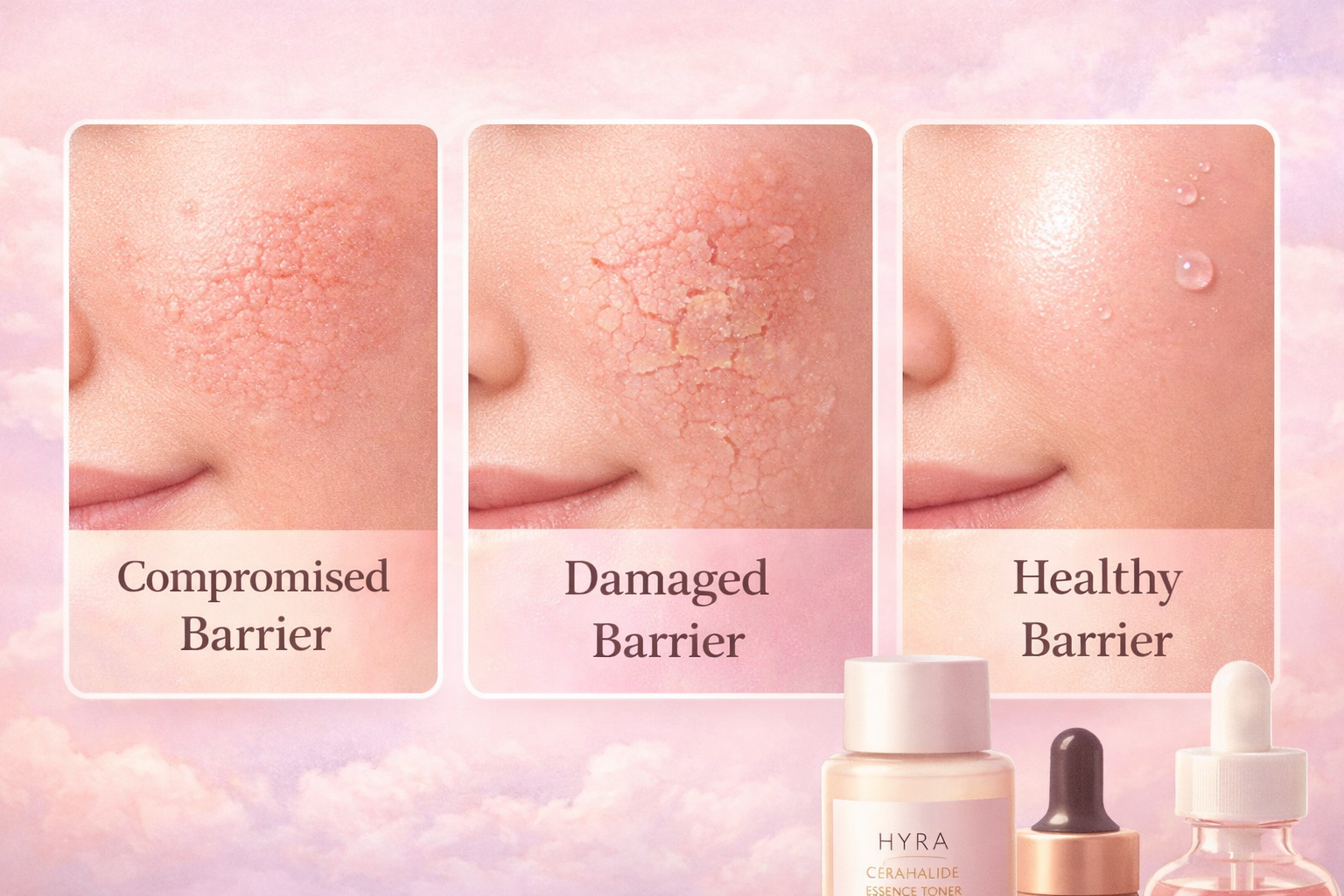
Mild Barrier Damage
Recovery Time: 7–10 Days
Signs: Slight tightness, mild dryness, occasional sensitivity
Common Causes: Weather changes, new skincare products, occasional over-exfoliation
A simple, gentle routine is usually enough.
Moderate Barrier Damage
Recovery Time: 2–4 Weeks
Signs: Persistent dryness, redness, product stinging, rough texture
Moderate damage usually occurs from using multiple actives at once. If your skin burns when applying moisturizer, your barrier still needs repair.
Severe Barrier Damage
Recovery Time: 4–8 Weeks
Signs: Constant irritation, peeling, burning sensation, extreme sensitivity
This often results from aggressive exfoliation routines. If this sounds familiar, see our guide on repairing over-exfoliated skin fast.
🛡️ The Hyra Edit Recommendation
For Stage 2 and 3 barrier damage, don’t guess your lipid ratios. The Barrier Rescue Edit is a pre-curated 3-step V’anhalla ceramide routine — Deep Cleansing Balm, Essence-In Toner, and Serum-In Cream — formulated with the exact ceramide-to-fatty-acid balance needed for moderate to severe recovery. No guesswork, no ingredient conflicts.
Shop The Barrier Rescue Edit →
What Your Skin Should Feel Like Week by Week
Recovery isn’t linear, but here’s a realistic guide to what to expect at each stage:
Days 1–3: Skin may still sting, feel tight, or look red. This is normal. Your barrier is in active distress. Focus on gentle cleansing and ceramide application only. Do not introduce anything new.
Days 4–7: Stinging should begin to reduce. Tightness may persist but should feel less acute. Redness starts to calm. If products still sting, your barrier is not ready for anything beyond the basics.
Week 2: Skin starts to feel more comfortable. Hydration retention improves. You may notice less flaking and a smoother texture. This is a critical phase — do not reintroduce actives yet even if skin feels better.
Week 3–4: For mild to moderate damage, skin should feel largely stable. Products absorb more evenly. Sensitivity decreases noticeably. You can begin considering a slow reintroduction of low-strength actives.
Week 5–8 (severe damage): Full recovery for severely compromised barriers. Skin resilience improves. Texture normalizes. Actives can be reintroduced very gradually with ceramide buffering.

Factors That Affect Your Recovery Timeline
Not everyone heals at the same rate. Several variables influence how quickly your skin barrier recovers:
Climate and environment: Cold, dry climates — like Canadian winters or low-humidity indoor heating — significantly slow barrier repair by accelerating TEWL. If you’re in a dry environment, a humidifier and occlusive moisturizer can make a measurable difference.
Age: Skin cell turnover slows with age, which means barrier repair takes longer in your 30s and 40s compared to your 20s. Ceramide production also naturally declines with age, making topical replenishment even more important.
Skin type: Dry and combination skin types tend to experience more severe barrier disruption and slower recovery. Oily skin types may recover faster but are not immune to barrier damage from over-exfoliation.
Severity of the trigger: A single over-exfoliation session heals faster than months of daily acid use. The longer the barrier has been compromised, the longer the recovery.
Consistency of your repair routine: Skipping ceramides or switching products mid-recovery resets progress. Consistency is the single most controllable factor in your timeline.
What Speeds Up Skin Barrier Repair
1. Gentle Cleansing
Use low-pH cleansers that do not strip natural oils. Cleansing should leave your skin comfortable — not tight.
2. Ceramides Daily
Ceramides replenish the lipids lost during irritation. Research indexed by the National Institutes of Health confirms that topical ceramides accelerate barrier recovery by restoring the skin’s lipid structure.
Barrier-supporting Korean skincare formulas like V’anhalla Ceramide Essence Toner help restore hydration and calm inflammation.
Ceramides repair. Hydration soothes. Both are essential.
3. Simplified Routine
Barrier recovery works best with fewer products. The most effective routines include a gentle cleanser, hydrating toner, barrier cream, and sunscreen.
You can learn how to structure a barrier-safe routine in our simple K-Beauty routine guide.
What to Eat During Skin Barrier Repair
Topical products do most of the work, but nutrition plays a supporting role in how quickly your skin barrier recovers from the inside out.
Omega-3 fatty acids: Found in salmon, walnuts, flaxseed, and chia seeds, omega-3s help maintain the skin’s lipid barrier and reduce inflammation. Studies suggest that omega-3 supplementation can improve skin hydration and reduce sensitivity in people with compromised barriers.
Ceramide-rich foods: Wheat, brown rice, sweet potatoes, and eggs contain glucosylceramides — precursors to skin ceramides. While topical ceramides are more direct, dietary sources provide systemic support.
Vitamin C: Supports collagen synthesis and skin repair. Found in citrus fruits, bell peppers, and leafy greens. Note: avoid topical vitamin C during active barrier damage, but dietary vitamin C is beneficial throughout recovery.
Hydration: Drinking adequate water supports skin hydration from within, though it doesn’t replace topical moisturization. Aim for consistent daily intake rather than sporadic large amounts.
Avoid: Excess alcohol, high-sugar diets, and processed foods can increase systemic inflammation and slow skin recovery.
The Biggest Mistake: Restarting Actives Too Soon
Most people delay healing by restarting treatments early.
Avoid temporarily: Retinol, AHAs, BHAs, Vitamin C
If your skin tingles when applying moisturizer, it is not ready. Wait until skin feels neutral — no sting, no tightness, no unusual shine.
According to the American Academy of Dermatology, allowing the skin barrier to fully recover before reintroducing active ingredients is essential for preventing recurring damage.
Personalized Routine Matters
Barrier repair depends on your skin type and lifestyle. If you’re unsure which products to use, take our Korean Skincare Quiz to build a personalized routine for your skin.
The right routine prevents damage before it starts.
Why Korean Skincare Focuses on Barrier Health
Korean skincare is built on a philosophy of prevention over correction. Rather than treating damage after it occurs, the K-beauty approach prioritizes maintaining a strong, hydrated barrier so that actives like retinol and acids can work effectively without causing harm.
This is why Korean formulas consistently feature ceramides, centella asiatica, panthenol, and fermented ingredients — all of which support barrier integrity rather than stripping it. The layering method (toner → essence → serum → moisturizer) is also designed to build hydration gradually rather than relying on a single heavy product.
When the barrier is strong, retinol works better, breakouts decrease, hydration improves, and skin becomes more resilient over time. For a deeper understanding of how barrier health underpins every aspect of your skincare routine, read our complete skin barrier blueprint guide.
At The Hyra Edit (formerly Hyra Beauty), we curate barrier-supporting Korean skincare designed for long-term skin health.
Build Your Barrier Recovery Kit
The fastest way to repair your skin barrier is to remove the guesswork. A pre-built barrier recovery kit gives you everything you need in one place — a gentle cleanser, ceramide toner, barrier moisturizer, and SPF — all formulated to work together without irritation.
If your skin is currently compromised, a curated routine removes the risk of accidentally introducing an incompatible product mid-recovery. Explore the Soothing Barrier Rescue Pack →
Final Thoughts
Skin barrier repair takes patience — but when you rebuild properly, your skin becomes stronger than before.
Healthy skin is not achieved through stronger treatments. It is built through consistent care, gentle routines, and barrier support.
Frequently Asked Questions About Skin Barrier Repair Timeline
How long does it take to repair a damaged skin barrier?
It depends on the severity. Mild damage typically improves in 7–10 days, moderate damage in 2–4 weeks, and severe damage can take 4–8 weeks or longer. Consistency with a gentle, ceramide-focused routine is the most important factor.
How do I know my skin barrier is healing?
Your barrier is healing when products stop stinging, tightness decreases, redness fades, and your skin starts feeling comfortable and calm again. Neutral skin — no sting, no shine, no tightness — is the clearest sign of recovery.
Can I speed up skin barrier repair?
Yes. Using ceramides daily, simplifying your routine, avoiding actives, and protecting your skin with SPF all accelerate recovery. Switching to a low-pH cleanser also makes a significant difference.
What slows down skin barrier repair?
Restarting exfoliants or retinol too early, using fragrance-heavy products, over-cleansing, and constantly switching products are the most common reasons barrier repair stalls.
When can I reintroduce retinol after barrier damage?
Wait until your skin feels completely neutral — no stinging, no tightness, no unusual shine. For most people this means waiting at least 2–4 weeks after mild damage, or longer for moderate to severe cases. Start with the lowest concentration, once or twice a week.
Does diet affect skin barrier repair?
Yes. Omega-3 fatty acids, ceramide-rich foods, and adequate hydration all support barrier recovery from within. Avoiding excess alcohol and high-sugar foods also reduces systemic inflammation that can slow healing.
Does climate affect how long barrier repair takes?
Yes. Cold, dry climates like Canadian winters accelerate transepidermal water loss and slow recovery. Using a humidifier, applying an occlusive moisturizer, and protecting skin from wind and cold can significantly improve your timeline.
How fast can I get barrier repair products in Canada?
The Hyra Edit ships within 2–4 business days across Canada and the USA. Orders are fulfilled from Calgary, Alberta in Canada and Salem, Ohio in USA — so Canadian and US customers typically receive their order faster than international alternatives.






Leave a comment
This site is protected by hCaptcha and the hCaptcha Privacy Policy and Terms of Service apply.